USDA Rural Development Loans 2026: The Zero-Down Mortgage Most Buyers Miss
How USDA loan income caps, eligible suburbs, and lower guarantee fees can beat FHA for the right buyer.
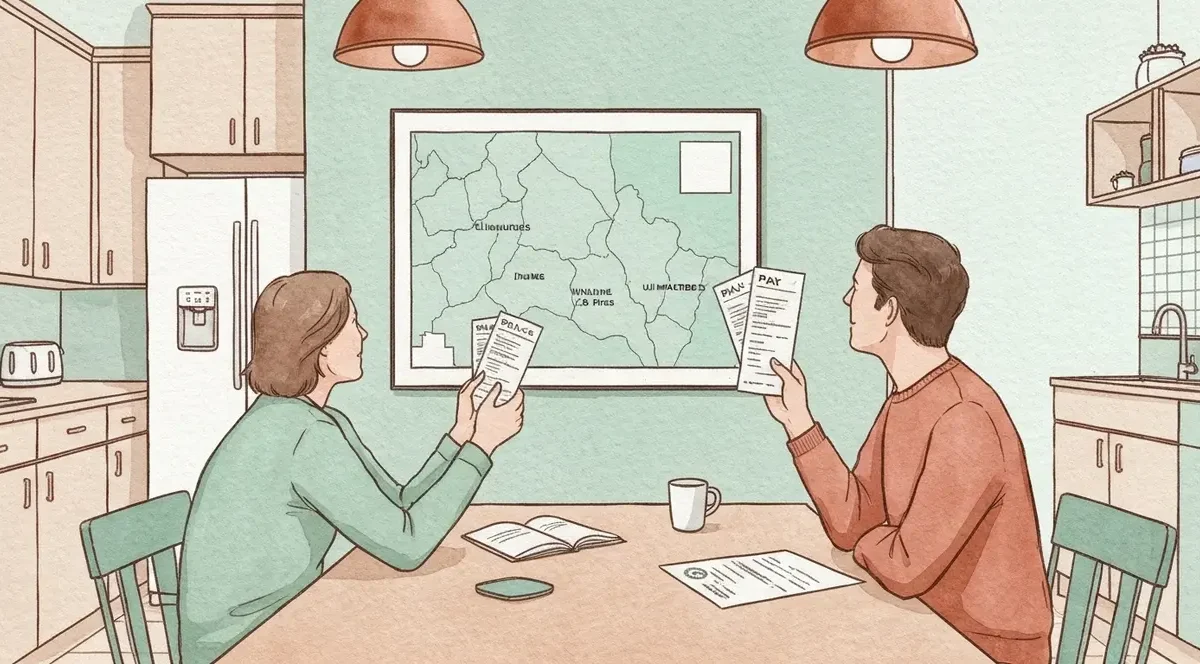
Picture this reader: lives in a town 22 miles outside Nashville, household income around $98,000, looks at conventional loan calculators and sees a $35,000 down payment requirement that feels impossible. That reader probably qualifies for a USDA Rural Development Loan and has no idea the program exists. The USDA Rural Development Loan is the only major federal mortgage program that requires zero down payment and isn’t tied to military service, yet most buyers never hear about it from their realtor or loan officer.
Here’s why it stays invisible: USDA loans take longer to close, pay smaller commissions to brokers, and require an extra layer of paperwork. So the industry quietly steers people toward FHA instead, even when USDA would save them thousands. I’m gonna walk you through the program the way I wish someone had walked me through it, in the order you’d actually use it: check geography first, then income, then math the fees against FHA, then file.
Step 1: Check the map before anything else
The first move is geography, not income. If your target property isn’t in a USDA-eligible area, nothing else matters. The good news is the eligible zone covers roughly 97% of U.S. land area, and it includes plenty of suburbs you wouldn’t expect. Communities 15 to 25 miles outside Atlanta, Nashville, Austin, and Indianapolis frequently qualify. We’re not talking about cornfields only.
The eligibility rules break down by population tier, and this is where most people get confused. Here’s the cleaner version:
• Up to 10,000 residents: qualifies automatically, no other test needed.
• 10,001 to 20,000 residents: qualifies if the town is NOT inside a Metropolitan Statistical Area (MSA).
• 20,001 to 35,000 residents: qualifies only if previously designated rural in the 1990, 2000, or 2010 Census AND the area shows a serious shortage of affordable mortgage credit.
The map was last revised using 2020 Census data. Some towns lost eligibility because they grew, others got added back. You can’t trust what was true three years ago. Pull up the official USDA eligibility tool and type in the exact property address before you do anything else.
I’ve filled out this form with clients a thousand times. Here’s the catch: an eligible town can contain ineligible pockets, usually newer subdivisions that pushed past a density threshold. Two houses on the same street can have different status. Verify the specific address, not the city name.
Step 2: Run your household income against the cap
Once geography clears, income is the second filter. For 2026, the standard cap in most areas is $119,850 for households of 1 to 4 people, and $158,250 for households of 5 to 8. High-cost counties get higher caps. The number comes from a formula: USDA sets the limit at 115% of the area median income, using HUD data for that specific county or metro.
Here’s where USDA differs from every other loan program and where I see people trip up. USDA counts the gross income of ALL adult household members, not just the ones on the loan application. Your spouse, your 19-year-old kid working part-time at Target, your mother-in-law who moved in last year, everyone’s income gets added together. The bank doesn’t care if they’re co-signing. They live there, they count.
The flip side is allowable deductions. You can subtract $480 per dependent child, $400 for any household member age 62 or older, and documented childcare or disability expenses. I’ve seen families who looked $4,000 over the cap on paper drop under after we ran the deductions properly. Don’t eyeball this. Get the worksheet and fill it out line by line. The difference between “you qualify” and “you don’t” is often a $2,400 daycare bill the loan officer forgot to ask about.
Step 3: Compare the fees against FHA, honestly
This is where USDA wins on math and almost nobody bothers to check. Grab a pen, let’s do the math together. USDA charges a 1% upfront guarantee fee (which you can roll into the loan) plus 0.35% annual fee on the unpaid balance, paid monthly. FHA charges 1.75% upfront mortgage insurance premium and 0.55% annual MIP.
On a $300,000 loan, the USDA upfront fee is $3,000 versus FHA’s $5,250. That’s $2,250 saved at closing. On a $250,000 loan, the monthly cost difference is roughly $42, which compounds to over $5,000 in 10 years. On a 30-year hold of a $250,000 loan, USDA saves around $15,000 total compared to FHA. That’s not a rounding error. That’s a kid’s first year of college.
Back at the bank we called this the silent margin. There’s stuff the bank’s system shows that the customer never sees, and this is exactly that. The loan officer’s commission was usually 25 to 40 basis points higher on FHA because of how the secondary market priced the loans. Nobody was committing anything wrong. The incentive just quietly pointed away from USDA. Three years ago I told a client that FHA would keep dominating the suburban first-time buyer market through 2025 specifically because of this commission gap, and that prediction held up almost word for word.
Step 4: Know when USDA actually beats FHA
USDA isn’t always the better tool. It wins cleanly when three conditions stack: the property is in an eligible area, your household income is under the cap, and your credit is at least 640. Drop any one of those and the picture changes.
FHA is the better pick when your credit score is under 580 (USDA lenders typically want 640 minimum even though the program technically allows lower), when you’re buying in a dense urban core that’s not eligible for USDA, or when your household income blows past the cap. FHA also has a published loan limit ($524,225 to $541,287 in 2026 for standard-cost areas), while USDA has NO preset loan limit. Your borrowing capacity is determined entirely by income and debt-to-income ratio.
Detail that makes all the difference: USDA isn’t restricted to first-time buyers. Move-up buyers can use it too. There’s no cap on seller concessions, which means the seller can pay all your closing costs if you negotiate it. And the upfront guarantee fee can be financed into the loan even if it pushes the loan amount above the appraised value. That last point is unusual and worth its weight in gold.
Step 5: File before rates move again
USDA rates in 2026 have been tracking in the 6.5% to 7.25% range for 30-year fixed loans, typically 0.25% to 0.50% below conventional rates because of the government guarantee. The USDA Direct Loan program (different from the Guaranteed Loan I’ve been describing, and only for low/very-low income borrowers) had rates as low as 5.125% as of October 2025, with payment assistance bringing the effective rate as low as 1% for qualifying households.
The application process runs through approved lenders for the Guaranteed Loan, not USDA directly. You apply with a bank or mortgage company that participates, they underwrite to USDA’s standards, then USDA issues the guarantee. Expect the closing timeline to run 45 to 60 days versus 30 to 45 for conventional. The extra time is the USDA review step, and there’s no way to speed it up.
Pull up your statement and look at what you’ve actually saved for a down payment. If it’s less than 10% of your target home price, USDA changes your math more than any other federal program. Spoiler: it’s worth more than it looks.
What to do this week
The USDA Rural Development Loan is the most generous federal mortgage program for the buyer who fits, and the most invisible because the industry earns less when you use it. If you’re that reader in the qualifying suburb 22 miles outside Nashville with $98,000 in household income, this program closes the down payment gap that conventional lenders treat as your problem.
Three profiles, three plays:
• Credit 640+, income under cap, suburban target: USDA is your first call, period. The fee savings versus FHA pay for a year of property taxes.
• Credit 580-639, income under cap: get quotes from both USDA and FHA lenders. Some USDA lenders flex below 640, most won’t. Have FHA as the backup, not the default.
• Income near or over cap, multiple adults in household: run the deductions worksheet before assuming you’re out. Childcare and dependent deductions move people under the line more often than you’d think.
I’m telling you this because I’ve seen it happen: buyers find out they qualified for USDA only after closing on an FHA loan, and the refund process is brutal. Two complications to watch. First, the property appraisal under USDA is stricter on condition than FHA, and a roof in marginal shape can kill the deal (ask for the seller to escrow repairs in the contract). Second, if any adult in the household picks up a side gig between application and closing, that income gets added and can push you over the cap (delay the 1099 work until after closing).
This week, do two things. Go to the official USDA eligibility map at USDA and type in the exact address of any property you’re considering. Then pull your latest pay stubs for every adult in the household and add up the gross annual figures against the $119,850 (1-4 person) or $158,250 (5-8 person) cap, applying the $480-per-child and $400-per-elderly deductions. If you land under the cap with an eligible address, call a USDA-approved lender Monday. For program rules and the homebuyer education resources, HUD covers the consumer-side guidance better than any third-party blog.