Extended Warranties Decoded: When to Pay and When Your Card Already Has You
Store warranties cost 10 to 30 percent of the item price while your credit card often covers the same thing free.
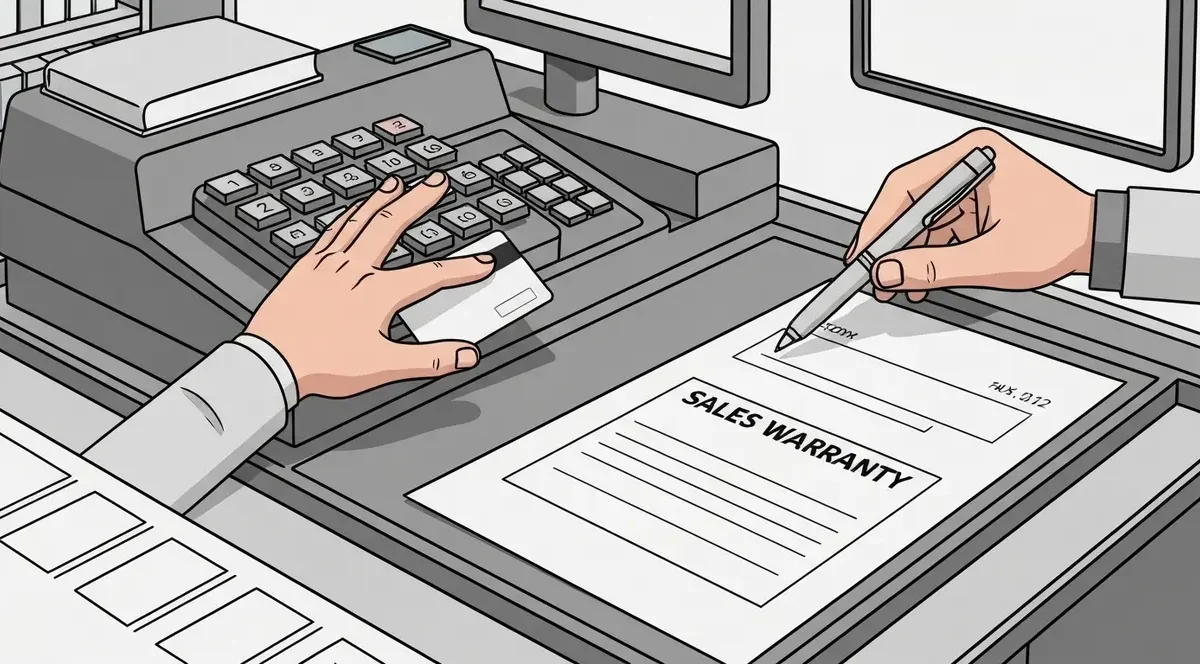
“I already spent $2,300 on the fridge. What’s another $299 for peace of mind?” That was a client of mine, standing at the checkout of a big-box store two years ago. I asked her one question that saved her the money. Do you know what your credit card extended warranty already covers on that exact purchase? She didn’t. Most people don’t. And that’s precisely the gap the retail industry monetizes to the tune of billions each year.
The extended warranty pitch is one of the most engineered moments in American retail. It happens at checkout, when you’ve already decided to buy, when your wallet is open, when saying no feels like tempting fate. The store clerk gets a commission. The third-party insurer collects a premium. You get a piece of paper you’ll probably never use. Let’s walk through this in the order it actually happens to you, from the moment you spot the item to the moment the warranty expires unclaimed.
Step one: before you swipe, know what protection you already own
Here’s the part nobody tells you at the register. Most major U.S. credit cards automatically extend the manufacturer’s warranty by one to two additional years, at no cost to you, with coverage up to $10,000 per item and a $50,000 annual account cap. That’s according to standard issuer terms as of mid-2026. If you’re paying with an Amex, Chase, or Capital One card, you likely already have what the store is trying to sell you for $200 to $500.
Before you sign anything, do the quick math on what your wallet already delivers:
• Chase Sapphire, Freedom, Ink lines: add one year to eligible manufacturer warranties of three years or less.
• American Express consumer and business cards: up to one extra year on original warranties of five years or less.
• Capital One Venture and Savor: similar one-year extension, subject to card tier.
• Citi Premier and Prestige: the strongest tier, adding up to 24 months on manufacturer warranties up to five years.
• Wells Fargo and most Citi entry cards: the benefit was quietly removed. Assume zero coverage unless you verify.
Pull up your card’s benefits guide before your next appliance purchase. Ten minutes now saves you from paying twice.
Back at the bank we called this the “double-coverage trap.” Customers would come in with a warranty claim, and I’d pull their statement and see they’d paid the store $299 for something Chase already covered for free. The store keeps the money either way. The insurer keeps the money either way. Only the customer loses.
Step two: understand what you’re actually buying at checkout
Store-sold extended warranties typically cost 10% to 30% of the item’s price. A $2,000 laptop carries roughly a $300 warranty. A $500 washing machine gets a $75 to $150 plan attached. And here’s the detail that makes all the difference: in most cases, the store selling you the warranty doesn’t fix the appliance. They hand your claim to a third-party insurance company, which then hires the lowest-bidding local technician to do the work.
The financial reality is even more lopsided. Forbes Advisor put it plainly in 2026: extended warranties statistically make more money for the companies selling them than they save for consumers. That’s not a slogan, that’s actuarial math. If the average claim paid out exceeded the average premium collected, the product wouldn’t exist. The global extended warranty market was valued at $147 billion in 2025 and is projected to reach $346 billion by 2033. That growth isn’t happening because customers keep winning.
I’ve analyzed thousands of household budgets. Clear pattern: the people buying the most warranties are also the ones least likely to file a claim when something breaks, because filing is slow, requires documentation they didn’t save, and often gets denied on a technicality about “normal wear” versus “defect.”
Step three: separate the categories, because they don’t play by the same rules
Not every warranty is a bad deal. The decision changes by product category, and lumping them together is where readers lose money in both directions. Small appliances and electronics rarely justify a plan. Large appliances sit in the middle. Cars are their own universe.
For electronics and small appliances, the picture is clear. Extended coverage on a $150 toaster oven can cost $20 to $40. Your credit card almost certainly extends the manufacturer warranty for free. Skip it. For refrigerators, washers, and dryers, the numbers get more interesting. Consumer Reports data cited in 2026 shows up to 31% of refrigerators need service within the first five years, 20% of washers within ten years, 16% of dryers. So repairs do happen. However, the average appliance warranty runs $25 to $50 per month, or $300 to $600 per year. Over five years, that’s $1,500 to $3,000 for something that might never need a claim, or a $400 repair that would have been cheaper to just pay out of pocket.
Cars are the category where the math gets serious. As of 2026, an extended car warranty averages $139 per month, or $900 to $2,000 per year. Multi-year contracts typically total $2,000 to $4,000. Dealer-sold service contracts are marked up 100% to 200% over the actual provider cost. That means the same coverage sold at the F&I desk for $3,500 might be available directly from a third-party VSC provider for $1,500. On a $49,000 average new car purchase, that markup alone can equal your first three months of payments.
Step four: the smarter approach, in order of what actually works
Here’s the sequence I’d walk through if I were making a warranty decision tomorrow. It’s not complicated, but the order matters.
First, check your credit card’s coverage before you buy. Second, put the item on that card, deliberately. Third, save the receipt and the manufacturer’s warranty documentation in a folder, digital or paper, so you can actually file a claim if needed. Fourth, for cars specifically, never accept the F&I office’s first offer. Get two independent VSC quotes. Fifth, for large appliances, self-insure by parking the equivalent of the warranty cost in a high-yield savings account. If nothing breaks, you keep the money and the interest. If something breaks, you pay the repair from that fund.
Detail that makes all the difference: credit card price protection, once a common companion benefit, has been eliminated from nearly all major U.S. cards since 2018. Don’t assume it’s there. Extended warranty coverage is still available on many issuers, but Wells Fargo dropped it entirely and Citi removed it from nearly all its cards as of June 2026. Verify your specific card, not what someone told you three years ago. This is money on the table, and most people don’t grab it because they never open the benefits PDF.
From theory to your statement this month
The extended warranty industry sells you insurance against outcomes that are either already insured elsewhere, statistically unlikely to occur, or cheaper to pay out of pocket when they do. The product isn’t fraudulent. It’s just structured so the house wins on average, and the house has gotten very good at making the pitch feel urgent at the exact moment your judgment is weakest.
Three profiles, three plays:
• New buyer, premium credit card holder: skip nearly all store-sold warranties on electronics and small appliances. Your Amex or Chase card already extends coverage. Verify the benefit PDF once, then trust it.
• Cash or debit buyer, no card protection: skip electronics warranties still, but consider one on a refrigerator or high-end washer if it costs under 8% of the item price. Above that, self-insure.
• New car buyer, financing through the dealer: never sign the F&I warranty at the same table. Get one third-party VSC quote before you agree. The $500 to $1,500 savings is real.
Two complications I’ve watched clients hit. First, the “I lost the receipt” problem. Credit card extended warranties require proof of purchase, and phone photos of receipts fade or get deleted. Fix: forward the digital receipt to a dedicated email folder the day you buy. Second, the “my card changed the benefit” problem. Issuers can and do modify coverage with 30 days’ notice. Fix: re-check your benefits page every January and before any purchase over $1,000.
The Romans had a phrase, caveat emptor, buyer beware. Two thousand years later it still describes the checkout line perfectly. And I’ll tell you the one honest doubt I still carry about this whole topic: I don’t know how much longer the free credit card extended warranty benefit will exist. The industry rollback is real, and if Amex or Chase follows Wells Fargo’s lead, the math for large appliances flips. That’s the trend worth watching.
This week, pull the benefits guide for your primary credit card from the issuer’s site, search the PDF for “extended warranty” and “purchase protection,” and write the coverage limits on a sticky note inside your wallet. Then, before your next purchase over $500, check the note. For deeper coverage rules and complaint data, the Consumer Financial Protection Bureau and the Federal Trade Commission both publish current guidance on warranty rights and disclosures.