Pharmacy Discount Cards vs Insurance Copays: The 2026 Savings Math
How GoodRx, SingleCare, and generic substitution can quietly return $180 to $600 a year to your budget
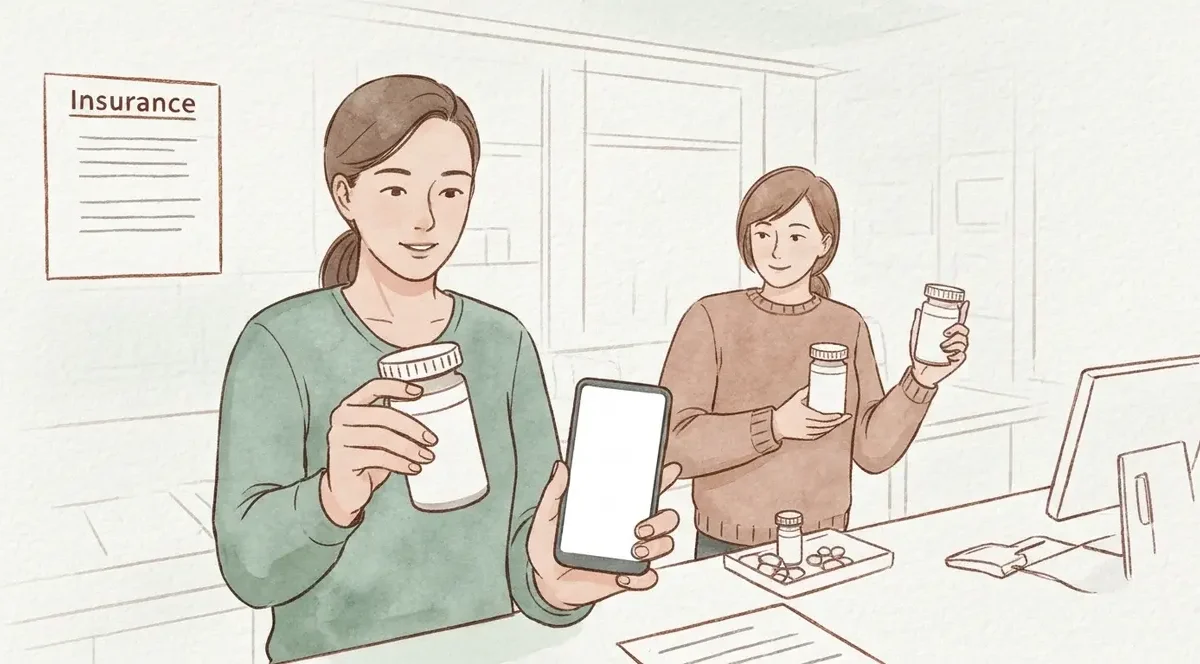
“An investment in knowledge pays the best interest,” Benjamin Franklin wrote in The Way to Wealth (1758), and nowhere does that hit harder in 2026 than at the pharmacy counter. I’m gonna be straight with you: when it comes to pharmacy discount cards, most Americans are paying the sticker price on autopilot while the person behind them in line walks out spending 40% less on the exact same pill. The rule I’ve used since my banking days still applies here: never accept the first number a system quotes you until you’ve asked what the second number is.
Prescription costs are one of those quiet monthly leaks that nobody puts on a budget line, and that’s exactly why they compound. Cardiovascular drug prices alone rose from roughly $100 in 2002 to about $455 in 2026, per Bureau of Labor Statistics data. If you take a maintenance medication and you’ve never once compared your copay to what GoodRx, SingleCare, or WellRx would charge cash, there’s a strong chance you’re leaving $180 to $600 a year on the counter. Let’s fix that.
The math that makes discount cards actually work
Here’s the part nobody wants to tell you at the pharmacy window: discount cards and insurance are an either/or decision, not a stacking play. You show one or the other. GoodRx cannot be combined with insurance or with any federal/state-funded program like Medicare or Medicaid, per GoodRx’s own policy. So the question isn’t “which is better in theory,” it’s “which is cheaper for THIS drug at THIS pharmacy today.”
Before you sign anything, do the quick math on your next refill:
• Check your actual copay. Not the estimate. The real number that hit your card last month.
• Look up the cash price on GoodRx, SingleCare, RxSaver, and WellRx for the same drug, same dose, same pharmacy.
• Compare across two or three pharmacies within a reasonable drive. CVS, Walgreens, Kroger, and Costco often quote very different numbers on the same generic.
• Pick the lowest number, whether that’s your insurance or a discount card.
Do that once per medication and you’re done for the year on that drug.
The scale of the opportunity is documented. GoodRx beats insurance copays roughly 37% of the time across its top drugs, per its May 2026 data. For an average household filling 4 to 8 prescriptions a year, using GoodRx alone saves $80 to $250 off pharmacy cash prices; comparing all four major cards adds another $40 to $120 on top. That’s real money for ten minutes of phone-tapping.
Why the same pill costs four different prices
Each discount card runs its own Pharmacy Benefit Manager contract, and those contracts negotiate different rates at different chains. That’s why the winning card for atorvastatin at your CVS might not be the winning card for the same drug at the Walgreens across town. There’s stuff the bank’s system shows that the customer never sees, and pharmacy pricing is exactly that kind of hidden layer.
Let me give you a real example. A neighbor of mine, mid-40s, moderate income, was paying $47 a month through her insurance copay for a generic SSRI she’d been on for years. She’d never questioned it because “it goes through insurance, must be fine.” When I sat down with her one Sunday, we pulled up SingleCare and saw the same drug, same 30-day supply, listed at $12 cash at the same pharmacy. Over a year, that switch put $420 back in her pocket. Same pill. Same store. Same pharmacist. Different card scanned.
She had two follow-up problems I want you to see coming. First, her insurance was still charging her the copay if she didn’t specifically tell the tech, “run this off-insurance with SingleCare.” Pharmacies default to insurance because that’s the safer legal path for them. You have to speak up. Second, GoodRx prices use real-time algorithms, so the number she saw at 8 a.m. sometimes shifted by pickup at 5 p.m. Not by much, but enough that she started screenshotting the price before driving over.
Generics: the boring lever that outperforms everything
If you want the single biggest smart-spending move in prescription drugs, it’s not the discount card. It’s asking your prescriber to write generic whenever a therapeutic equivalent exists. Generics cost approximately 79% less than their brand-name counterparts on average, per a Tebra survey of over 1,000 Americans published in April 2026. For common allergy medications, savings hit 83% per prescription.
Grab a pen, let’s do the math together. A 30-day supply of brand-name Adderall XR 15mg runs about $206. The generic amphetamine salts equivalent? Around $71. That’s $135 saved per month, or $1,620 saved per year on a single medication, per CU Connections’ 2026 pricing analysis. Now stack a discount card on top for the generic version, and the number can drop further at certain pharmacies.
Detail that makes all the difference: your prescriber isn’t automatically defaulting to generic every time. Some prescriptions get written “dispense as written” out of habit, and the pharmacy has to fill the brand. A single sentence at your next appointment — “please write for generic whenever therapeutically appropriate” — fixes this for every future refill. I’ve analyzed thousands of household budgets. Clear pattern: the families who never had that conversation with their doctor are the ones overpaying for years.
The manufacturer coupon trap most insured patients miss
Here’s a distinction that costs people real money because they conflate two very different things. GoodRx-style discount cards are one product. Manufacturer copay coupons (the ones drug companies send you for a specific brand-name drug) are something else entirely, and they carry a hidden long-term cost that got fresh scrutiny in 2026.
A JAMA study published April 6, 2026, led by Georgetown University’s So-Yeon Kang and covered by KFF Health News, confirmed what benefit managers have quietly known: manufacturer copay coupons do NOT count toward your deductible or out-of-pocket maximum under “copay accumulator” programs used by many commercial insurers. Translation: the coupon lowers what you pay this month, but you’re not making progress toward your annual deductible. Come December, you’ve spent the same on drugs but haven’t hit the threshold that unlocks lower cost-sharing on everything else.
Also worth knowing: Medicare and Medicaid beneficiaries are prohibited by federal anti-kickback law from using manufacturer copay coupons. And states including California and Massachusetts limit or prohibit coupon use when a generic is available. Nobody teaches you this at the pharmacy counter, but I’m gonna teach you now: manufacturer coupons can be a decent short-term tactic on an expensive brand with no generic option, but if a generic exists, the generic plus a discount card almost always wins on total annual cost.
Smarter approaches for the next twelve months
Once you know the levers, the playbook is straightforward. The people who save the most on prescriptions aren’t the ones with the best insurance. They’re the ones who treat every refill as a quick price-check instead of an automatic swipe. This is money on the table, and most people don’t grab it.
A few habits that compound quickly. Ask your prescriber for generic every visit, no exceptions unless there’s a clinical reason. Keep GoodRx, SingleCare, and WellRx installed on your phone; they’re all free. Before every refill, spend 90 seconds checking cash prices against your copay. If you’re on a maintenance medication, consider a 90-day supply — the per-pill cost usually drops meaningfully, and some warehouse pharmacies (Costco, in particular) don’t require a membership to use the pharmacy.
One more thing worth knowing for 2026: brand-name manufacturers are cutting list prices on at least 15 drugs this year, reducing gross brand revenues by $35 to $40 billion, with individual price cuts ranging from 25% to 85%, per Drug Channels’ January 2026 analysis. If you’re on a brand-name drug with no generic, ask your pharmacist twice a year whether the list price has moved. Sometimes it has, and nobody bothered to tell you.
How to apply this today
The counterintuitive truth about prescription savings is that the biggest wins don’t come from having better insurance. They come from acting like you don’t have any for ten minutes per refill, so you can see what the market actually charges. Insurance is one price. Cash-with-discount-card is another. Generic-plus-card is a third. In six months you’ll be deciding which of those to run for each medication in your household, and this is the framework.
Three profiles, three plays:
• Uninsured or high-deductible plan: discount cards are your default. Compare GoodRx, SingleCare, and WellRx on every prescription; the winner varies by drug and location.
• Standard commercial insurance with $15-25 copays: compare copay vs cash price on every generic. About one in three times, the card wins outright.
• Medicare or Medicaid: you cannot use GoodRx together with your benefits, and manufacturer coupons are off the table. Focus on generic substitution and 90-day supplies through your plan’s preferred pharmacy.
Back at the bank we called this “the second-quote habit,” and it’s the same muscle whether you’re pricing a mortgage or a statin. Two complications I’ve watched trip people up. First, pharmacies default to insurance unless you specifically ask them to run the discount card instead, so you have to say it out loud at the counter. Second, discount card prices shift in real time, so screenshot the quote before you drive over if it’s a meaningful amount. If the number at pickup is higher than the app showed, ask the tech to re-run it.
This week, before your next refill, pull your last three pharmacy receipts and write down the drug name, dose, and what you paid. Then spend 15 minutes on GoodRx and Consumer Financial Protection Bureau resources comparing cash prices and household budgeting guidance. If any drug shows a cash price at least $10 below your copay, that’s your next call to the pharmacy — and probably $120 or more back in your budget over the next year.