Grocery Spending: Where the Real Leaks Are (Not Coupons)
The grocery leak is not the candy at checkout. It is the mismatch of where you shop, how you pay and your card.
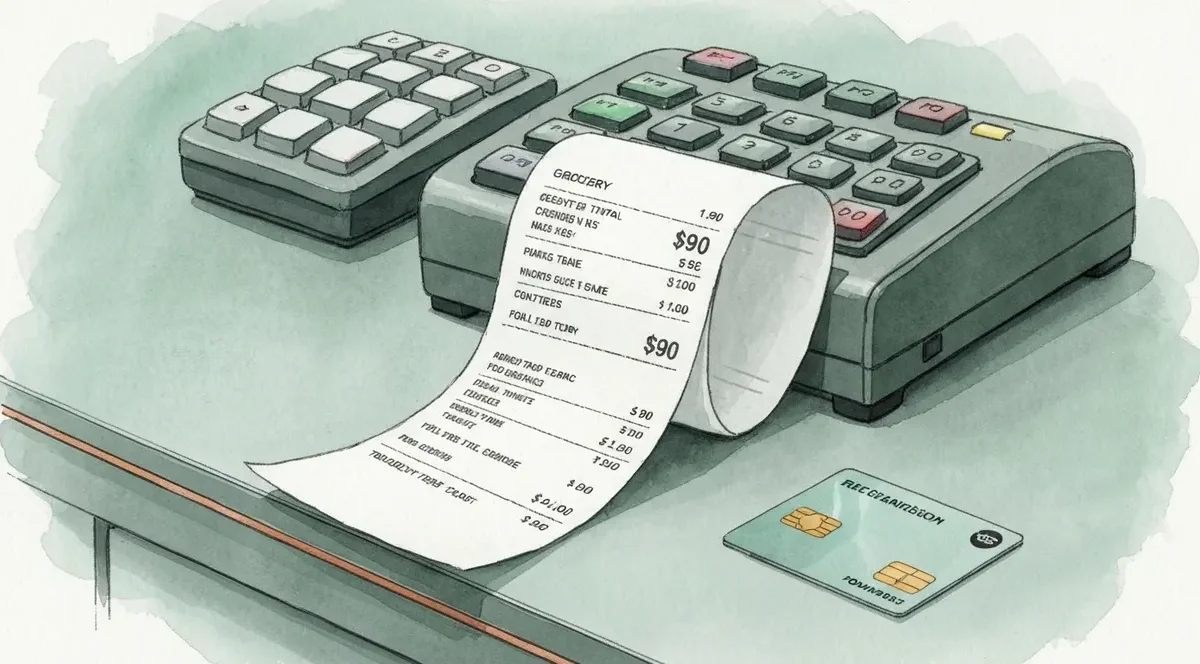
Picture the reader I’m writing this for: a 34-year-old who shops at Kroger every Sunday, has a Chase Freedom Unlimited buried in a drawer, and just noticed the receipt for two bags of groceries crossed $90 last week. Grocery spending is where most household budgets quietly bleed out, and the leak isn’t the chocolate bar at checkout. It’s the structural mismatch between where you shop, how you pay, and which loyalty program you bothered to set up.
Food-at-home prices climbed 2.9% year-over-year in April 2026, with fresh produce up 6.1% and beverages up 5.1%, according to the latest CPI release. The USDA projects 3.2% food inflation for the full year, faster than the 20-year average of 2.6%. That math means the average single adult is spending roughly $485 a month and a family of four around $1,430. If you’re not pulling at least 2-3% back on that spend through a deliberate stack, you’re handing the grocery chain a tip every visit.
Where the actual leak is
I’m gonna be straight with you: coupon-clipping is a low-ROI hobby for most households. The real leverage is structural, and it shows up in four spots most shoppers ignore. Pull up your statement and look at the last three months of grocery transactions before you read further. You’ll need that snapshot to apply any of this.
The four common leaks I see when I audit a household budget:
• Wrong card at the register. Most shoppers use a flat 1.5% card at a store that would pay 3-6% with the right product.
• No loyalty program tied to the receipt. Kroger Plus, Target Circle, Safeway for U. All free, all leaving cash on the counter when ignored.
• Sticker-price shopping. Buying the “bigger box” because it looks cheaper, when the unit price says otherwise.
• Shopping at a store excluded from your card’s bonus category. Walmart, Target, and Costco do not count as “supermarkets” on most rewards cards.
Fix those four and you’ve done more than a year of coupon clipping in one Saturday afternoon.
That last point is the one that catches almost everyone. The Amex Blue Cash Preferred pays 6% at U.S. supermarkets on up to $6,000 a year. Use it at Walmart? You get 1%. Same dollars spent, six times less back. The card’s category coding ignores superstores and warehouse clubs by design, and nobody at the bank is going to call to warn you.
Matching the card to the store you actually use
Here’s the part nobody wants to tell you: the “best grocery card” depends entirely on where you shop. If your default is Kroger, Publix, Wegmans, or any traditional supermarket, the Blue Cash Preferred at 6% (capped at $6,000 annually, then 1%) can return up to $360 a year, easily covering its $95 annual fee for a household spending $500+ a month on groceries. The no-fee Capital One Savor pays 3% globally on groceries with no caps and no foreign transaction fees, which makes it the simpler pick for moderate spenders or anyone who travels.
The Citi Custom Cash quietly earns 5% on your top category each cycle (up to $500/month), and groceries qualify. The Amex Gold pays 4x Membership Rewards points at U.S. supermarkets on up to $25,000 a year, which optimizes around a 6.8% return when those points transfer to travel partners. If you shop at Whole Foods or order Amazon Fresh, the Prime Visa returns 5%, though you need the $139/year Prime membership in the math.
Now the superstore problem. If your weekly run is Walmart or Target, none of the cards above hit their bonus rate. Your move is a flat-rate 2% card (Citi Double Cash, Wells Fargo Active Cash, Fidelity Rewards Visa) as the default, OR the Target RedCard for 5% back on every Target purchase including the grocery aisle. I’ve analyzed thousands of statements. Clear pattern: the shopper who keeps a single rewards card “for everything” leaves 200-400 dollars a year on the table compared to the one who runs two cards matched to their two main stores.
The Marcus case: one shopper, $487 back
Let me walk you through a real case. Marcus, late 30s, married, two kids, household grocery spend around $1,100 a month split roughly 70/30 between Kroger and Costco. Before we sat down, he was running everything on a Chase Freedom Unlimited at 1.5% flat. Annual grocery rewards: about $198.
We restructured. Kroger purchases moved to a Blue Cash Preferred. At $770/month at Kroger, he hit roughly $9,240 in annual supermarket spend, capped at $6,000 at 6% ($360) plus $3,240 at the post-cap 1% ($32), minus the $95 fee. Net from Kroger alone: $297. Costco purchases moved to a Citi Double Cash at 2% (Costco only accepts Visa, so the Amex was out anyway). That’s $330 a year at 2% on $3,960 of warehouse spend, or about $79. Add the Kroger Plus card for fuel points and digital coupons, which Marcus estimated saved him another $18 a month at the pump and $7 a month in personalized offers. That’s another $300 a year, roughly.
Total annual return on the new setup: about $676. Improvement over his old single-card system: $478 a year, on the exact same grocery bill. No coupon-clipping, no extreme shopping, no brand-switching. Just matching the card to the store and turning on the free loyalty program. The setup cost him about 40 minutes one Sunday afternoon, including activating the Kroger Plus account and adding the Amex to his Apple Wallet.
Loyalty programs and unit pricing: the unglamorous wins
Back at the bank we called the loyalty-program gap “free money the customer declines.” Kroger Plus is free to join and stacks fuel rewards, digital coupons, and personalized cashback offers across Fred Meyer, Ralphs, King Soopers, Harris Teeter, and the rest of the family. Target Circle’s free tier earns 1% back, and the RedCard layers 5% on top. Safeway, Albertsons, Publix, Wegmans, and HEB all run similar programs. The signup takes three minutes at the register or in the app. The return shows up every visit, automatically, for the rest of your shopping life.
Unit pricing is the other unglamorous win. Required by law to be displayed in Connecticut and many U.S. states, the per-ounce or per-pound price is printed right on the shelf tag, usually in smaller font next to the sticker price. Comparing it across brands and package sizes is how you find out the “family size” cereal is actually 18% more expensive per ounce than the regular box this week. Or that the store brand pasta is 40% cheaper per pound than the name brand sitting next to it. Detail that makes all the difference: once you train your eye for unit price, you stop being fooled by “bigger is cheaper” packaging tricks within a month.
For high-frequency essentials (paper goods, cleaning supplies, pantry staples), the triple-stack works: combine a store sale, a digital manufacturer coupon, and a cashback app rebate on the same purchase. Done right, that pulls 40-60% off retail on specific items. I don’t recommend organizing your whole shopping life around it, but for the 10-15 items you buy every month no matter what, the stack pays.
Pulling the trigger without overthinking
Grocery savings isn’t a hobby. It’s a one-time setup project that pays dividends every Sunday for a decade. The shoppers who win aren’t the ones with the thickest coupon binder. They’re the ones who spent 45 minutes matching the right card to the right store, signed up for two loyalty programs, and then forgot about it.
Three profiles, three plays:
• Single adult, $400-500/month grocery spend, no annual fee tolerance: Capital One Savor at 3% flat plus the loyalty card at your primary store. Expected return: $144-180/year. Zero ongoing effort.
• Family of four, $1,000+/month, traditional supermarket primary: Blue Cash Preferred (eat the $95 fee, the math works above $500/month at supermarkets) plus a 2% flat card for warehouse runs. Expected return: $400-700/year depending on split.
• Superstore primary (Walmart/Target/Costco): Target RedCard for Target trips, Citi Double Cash for everything else. Skip the “grocery bonus” cards entirely. Expected return: $200-400/year.
Two complications I’ve seen burn people. First, the Blue Cash Preferred annual fee math breaks if your supermarket spend drops below about $4,000 a year. Set a calendar reminder at month 11 to check whether you actually hit the threshold. If not, downgrade to the no-fee Blue Cash Everyday before renewal. Second, the loyalty program apps occasionally fail to attach the digital coupon to your account before checkout. Always glance at the post-transaction email or receipt. If it didn’t apply, customer service will credit it back, but you have to ask within a few days.
Five years ago I told a roomful of clients that store loyalty apps would eventually beat paper coupons not because they were better designed, but because the data would let stores price-discriminate at the individual level. That happened. Your personalized Kroger offers are different from your neighbor’s because the algorithm knows what you buy. That’s also why ignoring the app means paying the “non-targeted” price, which is structurally higher.
This week, do three things: open your last three months of grocery transactions and total the spend, write down your two primary stores, and apply for the card that matches your top store using the criteria above. Then check your fuel rewards through resources at the USDA or compare card terms at Consumer Financial Protection Bureau before you sign anything. Think of it like setting up automatic bill pay: 45 minutes of annoyance once, then it just works while you sleep.